When I share my story of Mr. Berthoud and his — “When are you going to stop mortgaging your life?” — question. Or, how a prospect once told me the reason they didn’t hire me was because I didn’t own an apartment.
When I share these stories, the responses I get tell me everything about how universal these experiences really are.
Yes, it’s true: the details of these stories and the feelings they sparked are specific to me.
Yet, it’s almost as if everyone can relate to recognizing a pattern they were living out (even if it took someone else to bring it to their attention), or that feeling of having someone judge their choices.
And it’s also true that they contain universal truths about identity, belonging, and what we believe we deserve.
Poems do something similar: they express one specific, intimate story that manages to create the space for everyone to feel like it was written just for them.
When you take a snapshot of the conditions of your finances and your relationship with money right now —
What do you notice?
What do you feel?
What feels so incredibly personal to you?
If you are going through a challenging time, do you notice this context makes it feel even more personal?
What happens when you zoom out — what elements of your story would you describe as universal?
The “dance” between what’s personal and universal is ever-present. And, I see this all the time, most recently during a speaking engagement.
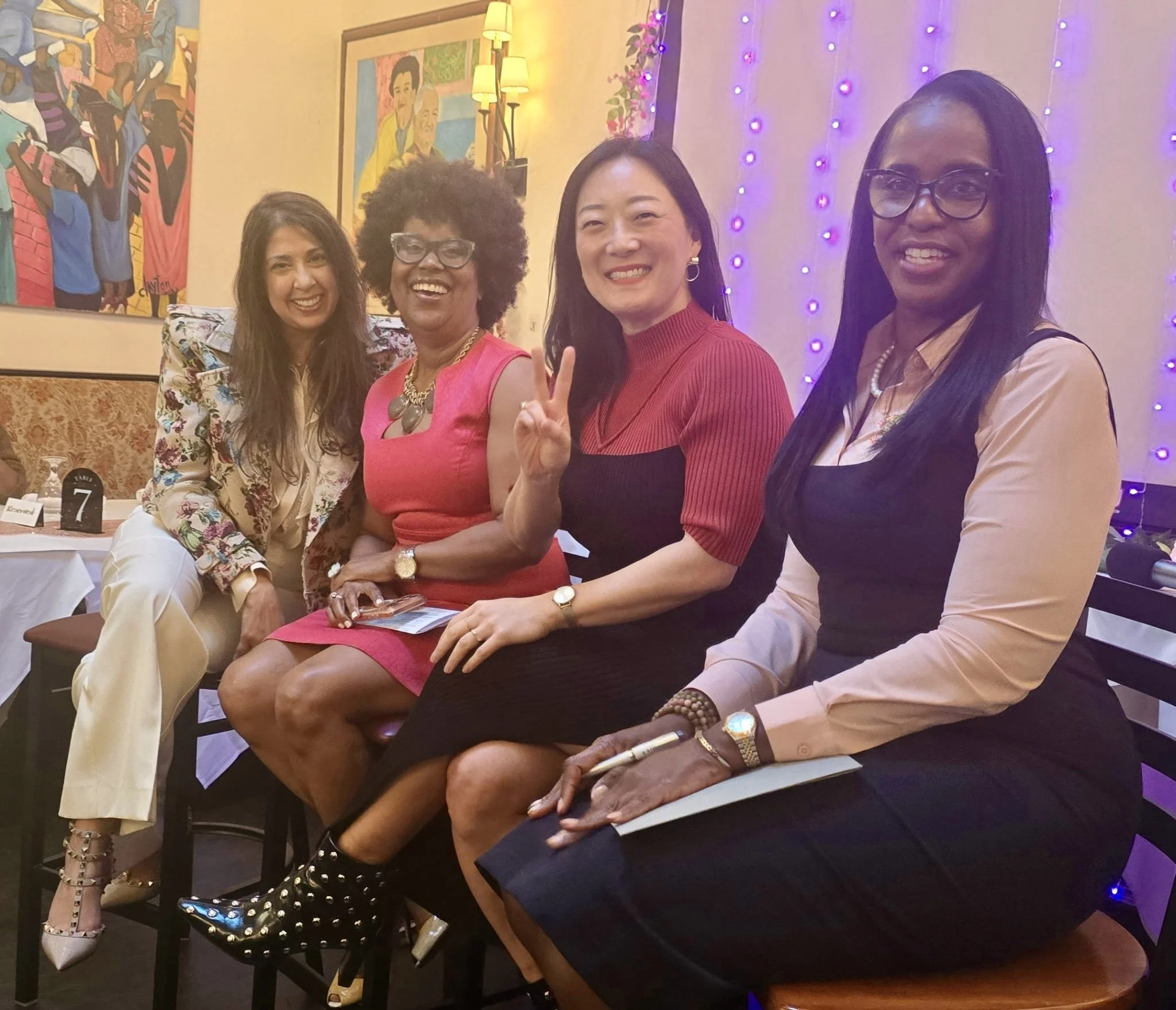
This past Thursday, I had the pleasure of speaking on a panel, “Leading with Financial Confidence: Women, Money, and Leadership,” alongside Carol Cho and Ruchi Pinniger. The event was hosted by the Zeta Nu Omega Chapter of the Alpha Kappa Alpha Sorority, Incorporated.
The facilitator, Rahesha Amon, kicked-off the panel by having each of us describe our relationship with money and how it evolved over time.
I shared my Mr. Berthoud story and how it taught me that what I need from money and what it needs from me evolves. It’s also what gave me a better understanding of the fact that what shows up in my relationship with money, is my relationship with myself, my business, and my clients — and the degree to which I’m putting them before myself. (And yes, if you’re wondering: there was definitely an audible reaction when I shared his poignant question.)
Ruchi shared a childhood memory of going to school where all of her classmates were wealthy and had designer things, and how she equated that with being happy. During her formative years, she thought once she could buy fancy things she, too, would be happy. Only to discover you can’t enjoy material things if you don’t feel whole on the inside.
Carol shared how curiosity helped her to shift from believing “if you weren’t born wealthy, that’s your lot in life.” It took asking herself some hard questions — including why her education wasn’t translating into a fuller financial life — before she could see how deeply her upbringing and culture had shaped her relationship with money. That recognition — and her decision to reject the starving artist trope she’d internalized — shapes how she now shows up for her clients: as a financial advisor who meets people where they are.
The Specific Is the Path to the Universal
Three women. Three different stories. Three completely different entry points into their understanding of their relationship with money.
And yet — the same room, the same head nods of recognition, the same collective exhale of yes, me too.
This is what poetry does at its best. Mary Oliver watching a grasshopper in a field becomes a meditation on what it means to be alive. Lucille Clifton writing about her body becomes a testament about worthiness and belonging. The detail is specific. The truth it carries belongs to everyone.
Your money story works the same way. The particulars are yours alone — the family dinner table where money was never discussed, the first paycheck you were proud of, the financial decision you’re still second-guessing, the number that makes you feel safe, the number that makes you feel ashamed. Those details are intimate. They are also, in the most profound way, everyone’s.
Because underneath the specifics, we are all navigating some version of the same questions:
Do I deserve this?Am I enough?Will there be enough?
What does money say about who I am?
These aren’t financial questions.They never were.
They are human ones.
And that’s the final parallel I’ll leave you with as we close out this month’s series: poetry and money are both, at their core, about the search for meaning.
The poet searches for the right word to hold an experience that resists language. You search for the right relationship with money to hold a life that feels like your own.
The work — in both cases — is deeply personal. And it connects you to something far larger than yourself.
What Story Are You Ready to Examine?
Over the past three weeks, we’ve explored what poetry and money have in common — the silence that shapes us, the rhythms we repeat, and the universal truths hiding inside our most personal financial details.
If anything in this series stirred something in you — recognition, discomfort, a question you haven’t been able to shake — I’d invite you to bring that to a conversation.
A discovery call is where we start. It’s a chance to look honestly at where you are, what patterns might be running in the background, and whether working together is the right next step for us to take.
Because here’s what I know after years of doing this work: the moment you decide to examine your money story with curiosity instead of judgment — that’s the moment everything becomes possible.
You can book your discovery call here.
[link]
And if you’ve been reading along all month — thank you. National Poetry Month gave me an unexpected gift this year: a new way to talk about the work I love most. I hope it gave you something worth sitting with, too.
About Jacquette

I love to ask questions and spark aha moments. I love to talk about why success with money is about more than just the numbers, and how the cultural impact on the intersection of money, business, and life matters–A LOT! And, I really hope I help people feel seen, heard, and not judged—especially since money is emotional and personal.