With Poetry and Money, What You Leave Out Shapes Everything
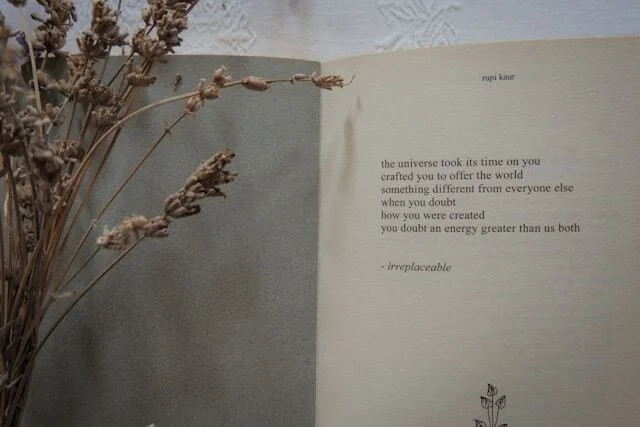
A recent NPR segment reminded me that April is National Poetry Month. I chuckled, because I flashed back to when I was in the 6th or 7th grade — a poem I’d written had been published in my town’s local newspaper.
While my classmates teased me, my mother was quite proud. I even found that particular newspaper amongst her papers when I was clearing out her house.
As a pre-teen, I had a very simplistic view of poetry. I thought what made a poem good was that the words rhymed.
But really, poetry isn’t about the literal meaning of the words written. It’s about so much more — it’s about how those words land.
What Poetry & Money Have In Common
Today, I see several parallels between poetry and money.
For example, two people can read the same poem and walk away with a completely different understanding of its meaning.
And isn't this also true when it comes to money?
Two people can earn the same income yet feel completely different about their financial lives.
Thus, my unscientific proof that…
With poetry and money, it’s about interpretation — not just what’s experienced.
The Power of What Goes Unsaid
Poetry’s power often lives in what’s not written — the white space, the em dash, the word the poet chose not to use.
In poetry, white space isn’t passive — it’s doing active work. The pause means something. The line break changes how you read the next line. A poet chooses what to leave out as carefully as what to put in.
Your financial life works the same way — even when it’s unintentional.
The expenses you don’t track.
The budget you started but didn’t finish.
The retirement account from a previous employer that you still haven’t rolled over into your current IRA.
The money conversation you need to have with a loved one — or a client, or an employer.
The money story you’ve yet to examine.
These silent choices aren’t neutral. They’re making decisions for you whether you realize it or not.
Which is worth sitting with — along with this question:
What’s the financial white space in your life right now? What are you leaving on the page?
The Reason The White Space Exists
Here’s the thing about silence — in poetry and in money, it rarely exists by accident. It exists because something underneath it feels too exposed to name.
You don’t look at the account because seeing it would make you feel something you’re not ready to feel.
You don’t have the conversation because it might reveal something about you — your fears, your choices, your sense of worth — that you’re not ready to confront yourself, let alone expose to someone else.
This is what poetry understands that a spreadsheet never will: the numbers aren’t the whole story.
Underneath every financial decision — or financial avoidance — there’s an emotional truth waiting to be read.
The poet who writes into vulnerability isn’t being reckless. They’re being precise about something real.
And that same precision — that willingness to look directly at what’s there — is exactly what creates the conditions for your financial life to shift.
Who knew that poetry could help me make the case that financial success is an inside job — yet, here we are.
Because both are a mirror. And what a good mirror asks of you is simple, if not always easy:
Look beyond what you see on the surface.
Get curious about what’s underneath.
Challenge the story you’ve been telling yourself.
And stay open to something new — even when, especially when, it feels uncomfortable at first.
This is the first in a three-part series I’m writing this month in honor of National Poetry Month. Because it turns out, the more I sit with the parallels between poetry and money, the richer they get.
Next week, we’ll look at rhythm — because your financial life has a beat, whether you’re aware of it or not. And like any good poem, when one measure is off, you feel it everywhere.
Until then, I’ll leave you with the mirror.
What’s your financial white space telling you?
About Jacquette

I love to ask questions and spark aha moments. I love to talk about why success with money is about more than just the numbers, and how the cultural impact on the intersection of money, business, and life matters–A LOT! And, I really hope I help people feel seen, heard, and not judged—especially since money is emotional and personal.